
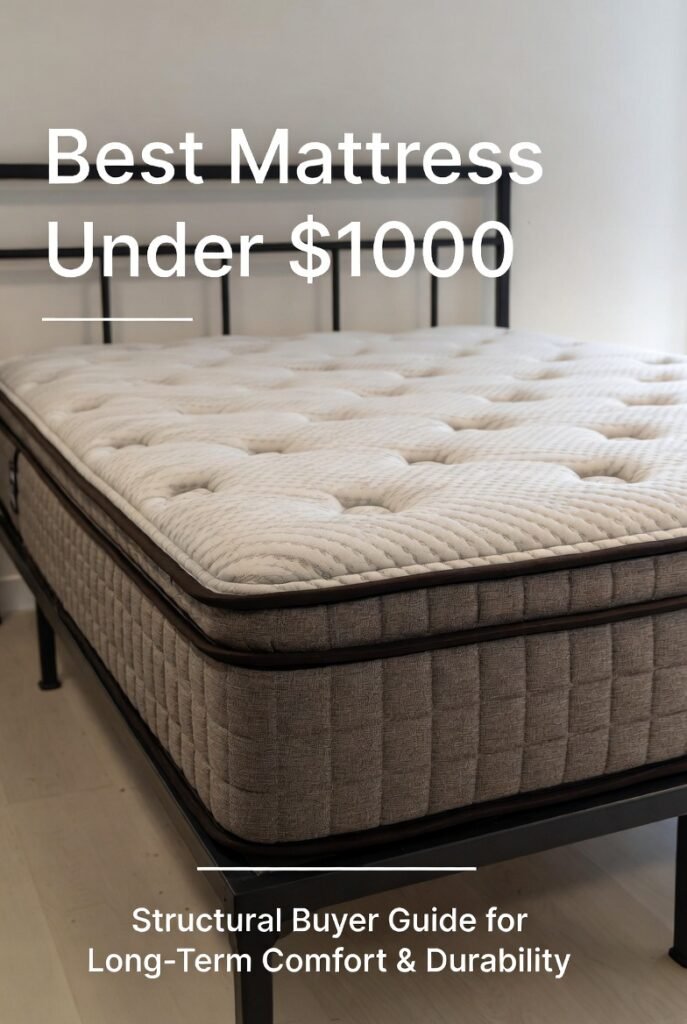
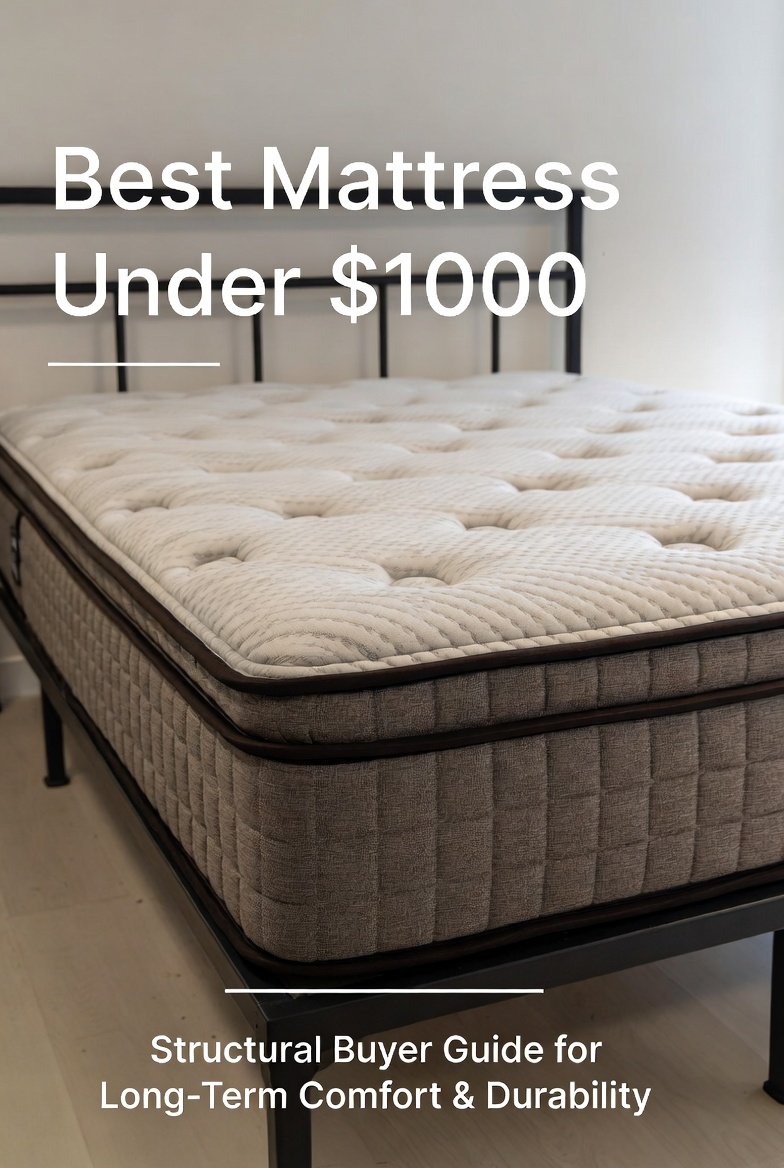
Best Mattress Under $1000
$1,000 is where mattress shopping quietly changes personality.
Below this threshold, purchases often feel temporary — practical decisions shaped by budget discipline. Cross it, and the conversation becomes longer-term. Expectations rise. So do consequences.
Yet this is also where buyers make some of their most expensive mistakes.
Because while a four-figure ceiling dramatically improves construction quality, it does not guarantee premium sleep. What it guarantees is margin — more engineering flexibility, denser materials, and better durability potential.
Whether that potential turns into lasting comfort depends almost entirely on how intelligently the mattress is chosen.
This buying guide exists to make that decision easier.
No inflated luxury framing.
No brand bias.
No affiliate theatrics.
Just a clear explanation of what truly improves at $1,000 — and where the boundary still holds.
Quick Decision Framework — Is $1,000 Your Smart Stopping Point?
Before exploring materials or features, answer the question most buyers skip:
Should $1,000 be your ceiling — or your entry point?
Stop at $1,000 if:
- You want long-term durability without luxury pricing
- You fall within an average or moderately heavy weight range
- You value structural reliability over indulgent softness
- You expect roughly 8–10 years of performance
- Best value mattress
Consider Moving Higher if:
- Edge support is critical
- You want advanced ergonomic zoning
- Latex appeals to you
- You prefer sustained plushness
- You are significantly above average weight
This fork prevents a surprisingly common pattern: upgrading emotionally instead of structurally.
Spending more only makes sense when the engineering meaningfully changes.
What $1,000 Actually Upgrades — Structural Comparison
The jump from $800 is evolutionary — but technically important.
Component | Under $800 | Under $1,000 |
Memory foam density | 3–4 PCF | 4–5 PCF possible |
Coil count (Queen) | 700–900 | 900–1,200 |
Transition layers | Basic | More engineered buffering |
Support cores | Stable | Higher compression resistance |
Expected lifespan | 6–8 years | 8–10 years |
None of these upgrades scream luxury.
But together, they dramatically reduce the likelihood of early structural fatigue — one of the biggest predictors of buyer regret.
Durability rarely announces itself on night one.
It reveals itself years later.
Why This Is the Highest True “Value-First” Tier
Many experienced shoppers intentionally stop here.
Why?
Because below $1,000, longevity becomes inconsistent. Above it, gains often grow smaller relative to price.
This tier tends to represent the market’s cost-to-performance peak.
Here, mattresses stop feeling provisional and begin feeling deliberate.
Comfort expands — but not recklessly.
Support strengthens — without dramatic price inflation.
It is the range where smart buyers quietly plant their flag.
Where Manufacturers Quietly Upgrade Construction
Most shoppers never see these changes — yet they strongly influence how a mattress ages.
Higher-Density Transition Foams
These layers prevent sleepers from sinking abruptly into the support core, reducing mechanical stress across the mattress.
Stronger Coil Gauges
Hybrids vs memory foam often introduce thicker steel coils, improving resilience and limiting body impressions.
Reinforced Edge Rails
Not always premium-level — but noticeably sturdier than sub-$800 builds.
Multi-Layer Architecture
Instead of relying on one thick comfort slab, better designs distribute load across several coordinated layers.
Improved Fabric Tensile Strength
Higher-quality covers resist stretching, helping maintain surface consistency.
None of these features photograph dramatically.
But they are exactly what separate mattresses that age gracefully from those that decline early.
Materials That Perform Exceptionally Well Under $1,000
Material quality becomes a defining advantage at this price.
Memory Foam
Higher densities improve weight distribution and slow softening — particularly valuable for combination sleepers.
Foam beds begin to feel controlled rather than engulfing.
Hybrid Designs
Often the strongest performers overall.
With better coil architecture and more stable foams, hybrids frequently strike an appealing balance between responsiveness, airflow, and durability.
At this tier:
Foam feels intentional.
Hybrids feel engineered.
Thickness Finally Correlates With Performance
Below $800, height can be theatrical.
Here, it begins to reflect real internal structure.
The sweet spot typically falls between 11 and 13 inches, where pressure relief and support coexist without excess.
Still, skepticism remains healthy.
Height only helps when supported by disciplined engineering.
Otherwise, it becomes camouflage.
Firmness Expands — Without Eliminating Mechanical Reality
Choice widens meaningfully at $1,000.
Side sleepers gain access to deeper pressure relief without immediate collapse. Even plush designs become viable — when anchored by strong support systems.
Guidance remains familiar:
- Back sleepers → medium-firm
- Side sleepers → medium to medium-soft
- Stomach sleepers → firm
Yet the safest long-term strategy remains unchanged:
alignment first, softness second.
Comfort adapts.
Spines remember.
Cooling Improves — But Expectations Should Stay Grounded
Airflow generally benefits from:
- more breathable foams
- upgraded fabrics
- stronger hybrid ventilation
Still, this is passive temperature regulation.
For extremely hot sleepers, structural airflow matters far more than branded cooling narratives.
Marketing often exaggerates what physics quietly limits.
$1,000 vs $1,500 — The Upgrade Many Buyers Misjudge
The psychological gap feels large.
The structural gap is selective — but real.
Above $1,200–$1,500 you typically begin to encounter:
- advanced zoning
- latex integration
- heavier coil systems
- luxury pressure mapping
- longer durability curves
Understanding this boundary prevents price drift, where shoppers upgrade repeatedly without a clear structural reason.
If those features matter, step upward confidently.
If not — $1,000 often remains the rational equilibrium between cost and engineering.
Longevity — The Honest Timeline
For average sleepers:
Years 1–3: Stable comfort and alignment
Years 5–6: Early softening appears
Years 8–9: Structural fatigue becomes noticeable
Heavier bodies accelerate wear. Couples compress materials faster.
Yet compared to lower tiers, degradation tends to occur more evenly — avoiding the sudden “failure” feeling common in cheaper beds.
At this level, mattresses begin behaving like long-term household equipment rather than replaceable goods.
The Reliability Principle — Why Simpler Often Ages Better
When multiple options feel comparable, the safer decision is usually the mattress built with:
- fewer gimmicks
- clearer specifications
- slightly firmer architecture
Complexity can impress early.
Simplicity often survives longer.
Reliability rarely attracts attention — until it quietly outperforms flashier designs years later.
Who $1,000 Is Truly Enough For
Ideal if you:
✅ want durability without luxury inflation
✅ share a bed
✅ prefer balanced comfort
✅ expect close to a decade of usable life
Less ideal if you:
❌ demand hotel-level plushness
❌ prioritize ultra-strong edges
❌ want natural materials
❌ expect zero softening over time
No mattress escapes physics.
But better engineering delays its effects.
Common Mistakes Buyers Still Make
Even disciplined shoppers stumble here:
- chasing softness over structure
- paying for profile instead of density
- assuming price guarantees longevity
- ignoring sleeper weight
Higher budgets reduce risk.
They do not eliminate it.
Bottom Line
The best mattress under $1,000 is rarely the one with the longest feature list.
It is the one engineered with restraint — balancing comfort, support, and durability without pretending to be luxury.
For many households, $1,000 is where mattress shopping stops being a compromise and starts becoming a long-term decision.
Spend thoughtfully here, and you may never feel compelled to upgrade.