
Best California King Mattress — The Geometry Fix Most Tall Sleepers Discover Too Late
Most mattress mistakes are adjustable.
Choosing the wrong California king is not one of them.
Once the bed is delivered, positioned, and expanded into the room, reversing the decision becomes physically inconvenient, logistically expensive, and psychologically unlikely. Many buyers simply adapt — often by changing their sleep posture rather than changing the mattress.
That quiet adaptation is the real risk.
The California king is not a prestige upgrade.
It is a geometric correction tool — designed for bodies that extend beyond standard mattress proportions.
When buyers misunderstand this, they don’t just overspend.
They solve the wrong problem.
This size guide exists to prevent that outcome.
Not by persuading you toward the size — but by helping you determine whether your body and your room actually require it.
The Geometry Rule (Start Here Before Comparing Anything)
Forget brand names for a moment.
The California king decision is governed by a simple physical principle:
If your sleeping posture exceeds usable mattress length, comfort adjustments cannot compensate. Geometry must change.
You are likely a true California king candidate if at least one of the following is consistently true:
✔ You are roughly 6’1″ (185 cm) or taller
✔ Your feet regularly contact the mattress boundary
✔ You unconsciously bend your knees to avoid the edge
✔ Your pillows migrate upward overnight to create legroom
✔ You wake without obvious pressure pain — yet feel subtly un-restored
If none of these occur, length is probably not your constraint.
And upgrading introduces a new one: reduced width.
This is why the California king should never be treated as a default luxury tier.
It is a precision instrument.
Why the California King Exists at All
Standard kings maximize lateral freedom — space for partners to spread outward.
The California king does something fundamentally different:
It restores vertical neutrality.
When the body can extend fully:
- the spine settles naturally
- calves relax instead of hovering
- foot flexion decreases
- subconscious guarding disappears
Sleep becomes mechanically quieter.
But only when length was the original problem.
Otherwise, buyers often trade elbow room for unused mattress territory — a swap that rarely feels wise in hindsight.
The Width–Length Tradeoff Most Buyers Underestimate
Every mattress design negotiates space along two axes.
California king shifts that balance.
You gain approximately four additional inches of length — but surrender several inches of width compared to a standard king.
That tradeoff sounds minor on paper.
In lived space, it is not.
Reduced width becomes noticeable when:
- both sleepers have broad shoulder frames
- pets share the bed
- one partner rotates frequently
- diagonal sleeping is habitual
Here is the crucial insight:
Length solves extension problems.
Width solves territorial ones.
Choose the wrong axis, and the mattress quietly introduces the very friction you hoped to eliminate.
The Tall Sleeper Threshold Test
Before moving forward, run this quick self-classification.
You likely need length correction if:
- Your heels reach the mattress seam when fully relaxed
- You avoid stretching your legs upon waking
- Hotel beds feel mysteriously better when longer
- Foot contact interrupts deep sleep cycles
You likely need width instead if:
- Shoulder overlap wakes you
- Partner movement enters your sleep field
- You drift diagonally for space
- Arm positioning feels negotiated
This two-minute test prevents one of the industry’s most common sizing regrets.
Because the smartest upgrade is not the largest mattress.
It is the one aligned with your body geometry.
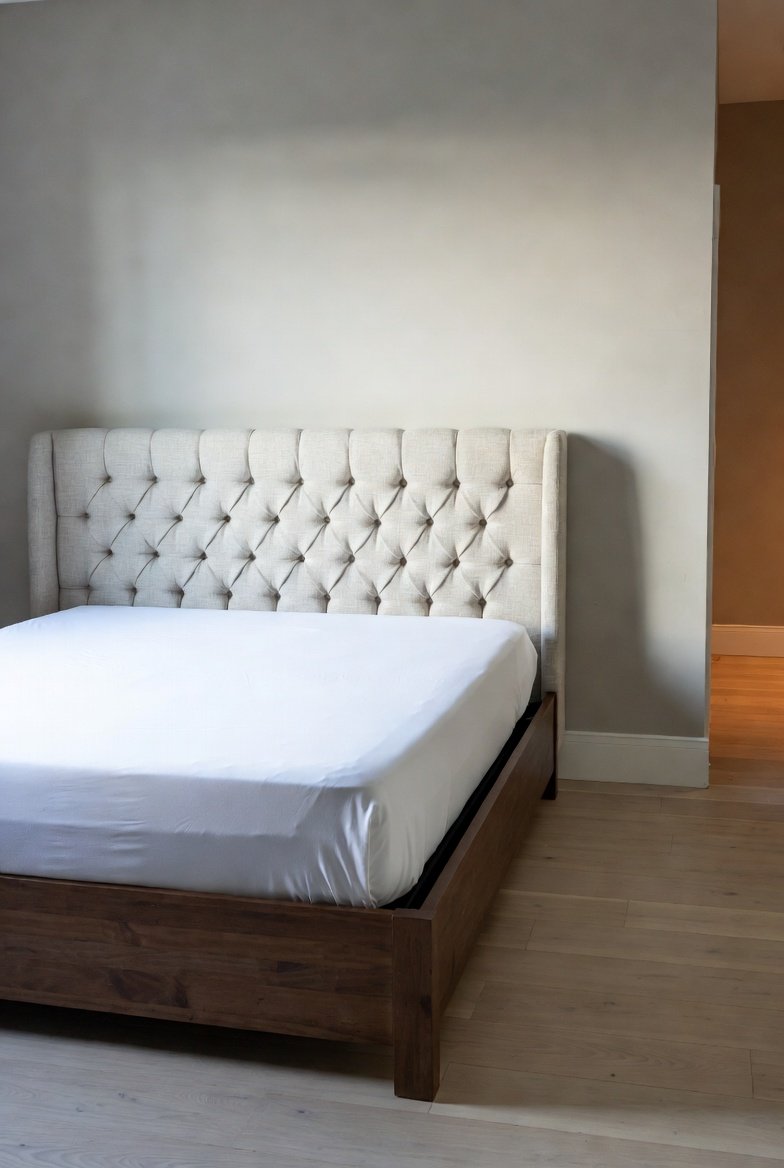
The Foot-Edge Failure Zone — Where Length Quietly Disappears
Side edges receive attention.
Foot edges rarely do.
For tall sleepers, that oversight matters enormously.
When the foot boundary lacks structural discipline, sleepers experience subtle but persistent signals:
Feet hover instead of resting.
Ankles remain slightly flexed.
Calves carry low-grade tension.
The brain compensates by encouraging micro-adjustments — tiny movements that fragment sleep without fully waking you.
Over months, fatigue accumulates without an obvious culprit.
Once sleepers begin curling to avoid that drop-off, the posture often persists even after upgrading — which is why correcting length early is smarter than adapting late.
Treat the foot edge as functional territory, not decorative margin.
Lengthwise Support — Alignment Across a Longer Lever
Longer bodies distribute weight differently.
The hips and shoulders sit farther apart, increasing what engineers call the support lever.
Mattresses that feel balanced for average-height sleepers can behave differently when that lever extends.
What matters is continuity:
- no soft hinge near the foot
- no abrupt resistance change
- no compression gradient pulling the body downward
Alignment must travel the full distance from head to heel.
When it does, tall sleepers often report something simple yet profound:
They stop thinking about their feet.
That cognitive silence is a powerful indicator the geometry is finally correct.
Motion Behavior on a Narrower King
Here is a nuance many buyers miss:
Because the California king is slightly narrower, motion travels a more direct path between sleepers.
Distance — the silent helper in standard kings — is reduced.
This does not demand perfect isolation.
But it does elevate the importance of stability.
Think of it this way:
Distance is a buffer.
Construction is the solution.
When both cooperate, sleepers remain in separate kinetic worlds.
When they do not, width regret often surfaces before length appreciation.
Room Geometry — The Constraint That Appears After Delivery
Mattresses reshape rooms.
The California king extends deeper into space, subtly rewriting how the bedroom layout functions.
Common aftereffects include:
- tightened walkway flow
- restricted door swing
- compressed visual openness
- longer reach to nightstands
None of these ruin a room — but together they can create low-grade friction felt every day.
Measure more generously than you think necessary.
Comfort should not end where the mattress begins.
The Expensive Wrong Upgrade
Returns on oversized mattresses are rarely simple.
Transport is harder.
Packaging is gone.
Motivation fades.
Many buyers adapt instead — convincing themselves the difference is negligible.
But sleep is cumulative.
A slightly misaligned surface compounds across thousands of nights.
The real cost is not the mattress.
It is the years spent sleeping around a solvable constraint.
Firmness Through a Biomechanical Lens
Firmness labels flatten reality — especially for tall bodies.
The question is not whether a mattress feels soft or firm.
It is whether resistance scales proportionally along a longer frame.
General orientation:
- Tall back sleepers usually benefit from medium-firm calibration that preserves spinal neutrality.
- Tall side sleepers need pressure accommodation without lengthwise sag.
- Stomach sleepers should avoid surfaces allowing the hips to drift below the chest.
Alignment outranks feel.
Always.
Budget Reality — Where Compromises Tend to Appear
Lower-priced California kings can perform adequately, but refinement often gives way to structural simplicity.
Typical concessions include:
- thinner comfort architecture
- less disciplined edge reinforcement
- simplified internal layering
- Best mattress
These mattresses rarely fail overnight.
They soften gradually — particularly near the foot boundary.
If longevity is the priority, modestly increasing budget often produces disproportionate lifespan gains.
Sleep economics favors durability.
When the California King Is Actually the Wrong Choice
Authority means drawing boundaries.
Avoid this size if:
- shoulder crowding already disrupts sleep
- both partners need lateral territory
- the room barely accommodates added depth
- maneuverability matters for future moves
Sometimes spatial harmony outperforms geometric correction.
The smartest buyers respect both.
Failure Modes — How This Size Breaks Differently
Every mattress size fails in its own way.
Queens often reveal length stress early.
Standard kings expose edge fatigue across width.
California kings fail more quietly.
The usual sequence:
foot-edge softening → subconscious curling → posture drift → reduced recovery.
Recognizing this pattern early protects long-term sleep quality.
The California King Stop Signal
You likely chose correctly when:
✔ Your feet rest fully without awareness
✔ Leg tension disappears
✔ Morning stiffness declines
✔ You stop adjusting your posture overnight
Warning signs appear quickly when the choice was wrong:
- shoulder compression
- diagonal drifting
- increased partner awareness
Trust these signals.
The body recognizes geometric fit faster than the mind does.
Bottom Line — Precision Beats Size
The best California king mattress is not about luxury, branding, or thickness.
It is about respecting human proportions.
For tall sleepers, success looks like:
- uninterrupted extension
- a dependable foot boundary
- alignment across a longer span
- a room that still breathes
Chosen correctly, the California king is not an indulgence.
It is a biomechanical correction — one that restores sleep to its natural posture.
And once posture is restored, sleep often becomes quieter than you remembered possible.