
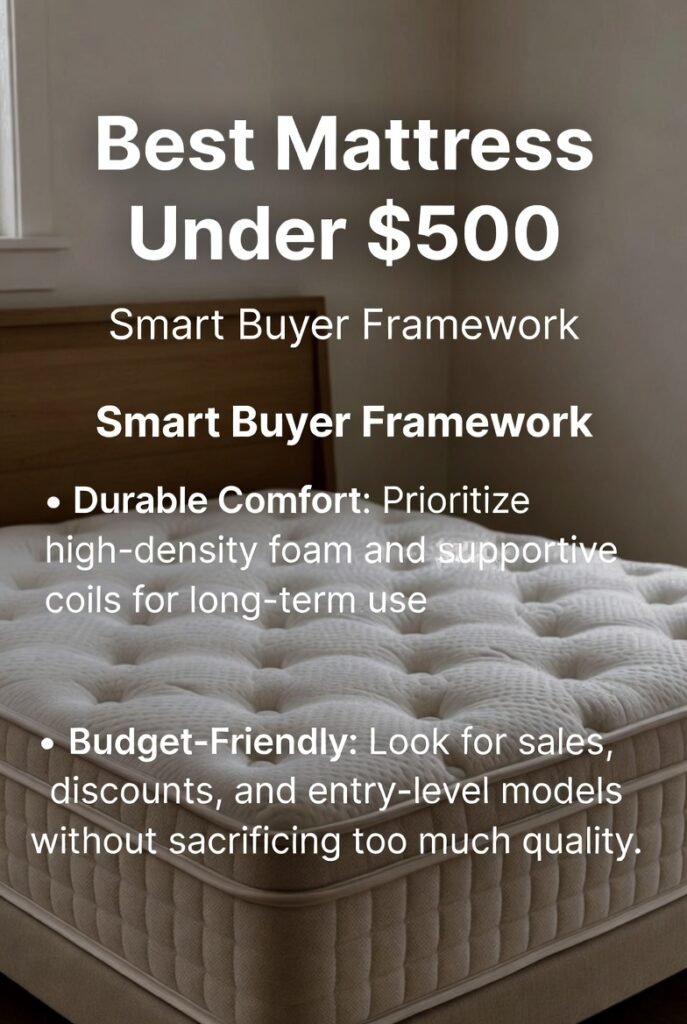
Best Mattress Under $500
Most mattresses under $500 feel comfortable for the first few months.
The real test begins later — usually somewhere between month six and month twelve — when hidden material shortcuts begin to reveal themselves. Support fades slightly. Foam softens unevenly. Alignment shifts just enough to notice.
This is why buying a budget twin mattress isn’t about chasing comfort.
It’s about avoiding structural regret.
At this price point, good sleep is absolutely achievable — but only for buyers who understand where manufacturers cut costs and which compromises actually matter.
This guide exists to give you that clarity.
No hype.
No fake luxury claims.
No brand pushing.
Just the structural reality of what holds up — and what quietly fails — under $500.
Quick Reality Check: What You Can Actually Expect Under $500
Before diving deeper, reset expectations. Budget queen mattresses are engineered around restraint.
Feature | Realistic Expectation | Common Marketing Myth |
Lifespan | 4–6 years | “10+ year durability” |
Cooling | Moderate airflow | “Ice-cooling technology” |
Edge support | Basic stability | “Reinforced perimeter” |
Plush feel | Temporary softness | “Hotel-level luxury” |
Motion isolation | Good in foam builds | “Zero motion transfer” |
Understanding these boundaries instantly removes about 80% of buyer mistakes.
The goal isn’t perfection.
The goal is predictable performance.
What the $500 Price Line Actually Represents
Think of $500 less as a budget — and more as a structural boundary.
Below it, manufacturers must simplify construction to control production costs.
That usually means:
- thinner comfort layers
- moderate foam density
- fewer reinforcement systems
- simpler coil designs
None of this automatically signals poor quality.
But it does mean there is no margin for unnecessary features.
Well-designed simplicity often outperforms feature-heavy builds at this price.
A strong mattress under $500 typically delivers:
✅ consistent support for average-weight sleepers
✅ reliable pressure relief
✅ stable motion control
✅ predictable wear patterns
What it rarely delivers:
❌ advanced zoned ergonomics
❌ dense natural latex builds
❌ premium edge systems
❌ decade-long durability
Accept this early — and your buying decisions immediately improve.
Cheap vs. Affordable — The Difference That Actually Matters
Not all budget mattresses fail the same way.
Cheap mattresses chase showroom comfort.
Affordable mattresses prioritize structural discipline.
Cheap designs often use ultra-soft foams that feel impressive on night one — then compress rapidly within a year.
Affordable builds usually feel slightly firmer at first but maintain spinal alignment far longer.
The difference almost always traces back to foam density.
Durable Budget Density Signals:
- Base foam: 1.8–2.2 PCF
- Memory foam comfort layer: 2.5–3.5 PCF
Anything significantly lower tends to fatigue faster.
Density is rarely advertised prominently — but it is one of the strongest predictors of mattress lifespan.
How to Choose the Best Mattress Under $500 (Quick Decision Framework)
Instead of chasing brands, anchor your decision around four variables:
1. Sleeper Weight
- Under 200 lbs → most medium builds perform well
- Over 230 lbs → prioritize firmness and coil support
2. Sleep Position
- Back sleepers → medium-firm for alignment
- Side sleepers → medium with controlled pressure relief
- Stomach sleepers → firm only
3. Durability Tolerance
Ask yourself:
Are you comfortable replacing this mattress in ~5 years?
If yes — budget works beautifully.
If not — consider moving toward the $700–$900 tier.
4. Comfort vs Alignment Bias
Buyers who prioritize alignment almost always report higher long-term satisfaction than those chasing plushness.
Structure ages better than softness.
Every time.
Materials That Quietly Perform Best
At this price, materials matter far more than branding.
All-Foam Mattresses
Often the safest category.
Why?
Foam systems wear gradually rather than catastrophically.
Look for:
- medium to medium-firm builds
- thinner comfort layers
- stable base foam
Avoid extremely soft profiles.
Hybrid Mattresses
Hybrids under $500 can work — but require scrutiny.
Entry-level coil systems typically contain 400–600 coils in a queen, compared to 800+ in premium builds.
Lower coil counts aren’t automatically bad, but they reduce long-term resilience.
Rule of thumb:
👉 Foam = predictable aging
👉 Hybrid = better airflow, higher variance
Choose hybrids only when specifications are transparent.
Thickness Is One of the Most Misleading Signals
A 14-inch mattress under $500 almost always reaches that height using low-density filler foam.
Those layers compress quickly — often within the first two years.
Meanwhile, a disciplined 8–10 inch mattress built with firmer materials frequently outperforms thicker designs over time.
Height doesn’t equal support.
In the budget category, restraint wins.
Firmness Is Not Just Comfort — It’s Structural Insurance
Soft mattresses under $500 carry risk.
They rely on materials that simply cannot maintain that softness under repeated load.
Medium to medium-firm surfaces distribute body weight more evenly, slowing material fatigue.
General guidance:
- Back sleepers → medium-firm
- Side sleepers → medium
- Stomach sleepers → firm
Choosing softness over structure is one of the fastest routes to buyer regret.
Cooling: What Actually Helps (And What Doesn’t)
True active cooling rarely exists at this price.
Instead, focus on passive heat management.
What Helps:
- open-cell foam
- breathable knit covers
- coil airflow
What Doesn’t:
- vague “gel infusion” claims
- thick pillow tops
- heavy foam stacks
If you sleep warm, prioritize airflow — not marketing language.
What Sleep Experts Quietly Avoid Under $500
Industry professionals tend to sidestep certain designs entirely:
- ultra-plush foam builds
- budget mattresses exceeding 12 inches
- fiberglass fire barriers without disclosure
- unclear density specs
- coil counts that aren’t published
Transparency is often a stronger quality signal than branding.
When manufacturers hide specifications, it usually means the numbers aren’t competitive.
Longevity — The Honest Timeline
For an average sleeper:
Year 1: Stable support
Year 3: Noticeable softening near pressure zones
Year 5: Performance decline becomes measurable
Heavier sleepers and couples typically accelerate this timeline.
The goal is not preventing wear.
It is ensuring wear happens evenly.
Who a Mattress Under $500 Is Actually Perfect For
This price tier works exceptionally well if you:
✅ value smart spending
✅ prefer medium support
✅ replace mattresses every 5–7 years
✅ need a guest-room or starter setup
Less ideal if you:
❌ expect hotel-level plushness
❌ require advanced pressure mapping
❌ want natural materials
Budget mattresses reward disciplined buyers — and quietly punish optimistic ones.
The Decision That Matters Most
The defining choice isn’t brand.
It isn’t thickness.
It isn’t even material.
It’s this:
Initial comfort vs long-term alignment.
Buyers who choose alignment almost always sleep better over time.
Not because the mattress feels luxurious…
…but because their spine stays supported long after the first impression fades.
Bottom Line
A great mattress under $500 isn’t the one that feels impressive in the showroom.
It’s the one that still feels acceptable years later.
Favor structure over softness.
Favor simplicity over features.
Favor transparency over marketing.
Do that — and this price range can deliver genuinely restorative sleep without overspending.
A $500 mattress rewards disciplined buyers.
And quietly exposes careless ones.